




Rebels, Walls and Enigmas: Walking Tour of Berlin's Vanished Canal




 Buy for a Group
 Reviews
 About the Tour
 About the Tour
Berlin's Luisenstadt district played a key role in shaping the city we know today, yet surprisingly little of it survives. On this walking tour, you'll follow the route of a vanished 19th-century canal that once cut through it, linking the River Spree in Berlin-Mitte with a busy inner-city harbour in Berlin-Kreuzberg.
Along the way, you'll discover how this waterway later became part of the Berlin Wall border strip—and how local residents reclaimed it after decades of division.
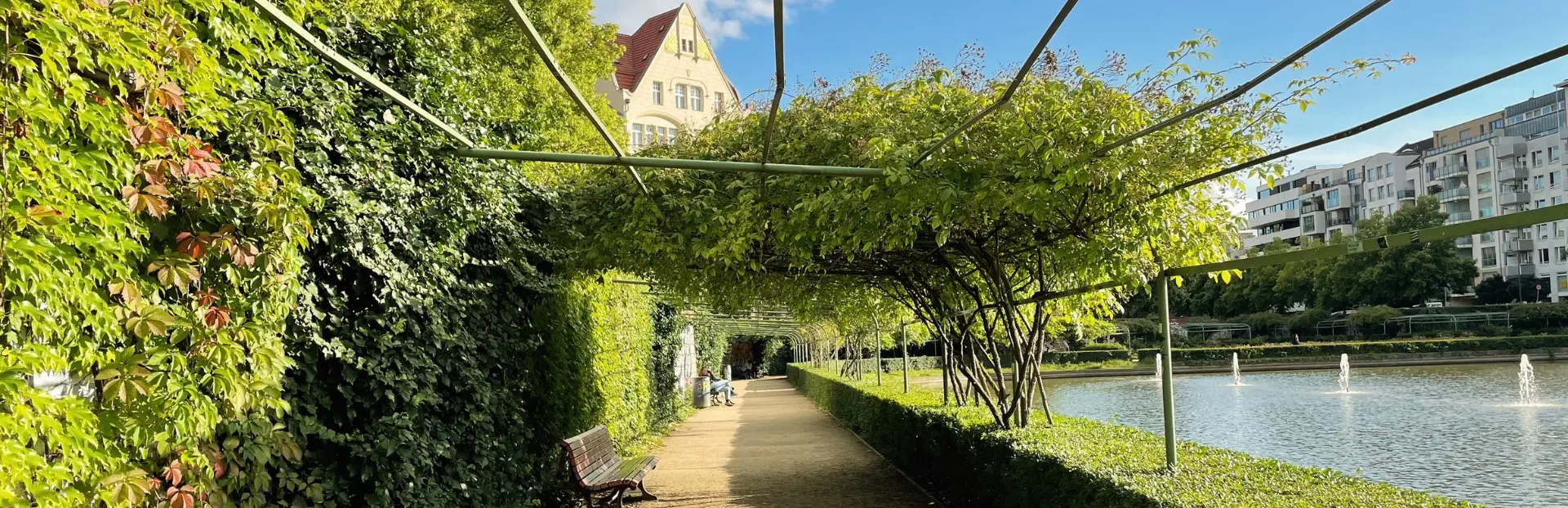
The tour begins beside the former canal - transformed into a chain of gardens - just a short walk from the Spree. From there, you'll stroll along Bethaniendamm, past Sankt-Thomas-Kirche and one of Berlin's oldest hospitals, tracing the canal's forgotten course through Oranienplatz—a neighbourhood that escaped large-scale demolition thanks to local activists and squatters in the 1970s and 80s.
As you walk, you'll hear stories of revolution, resistance and reinvention: the workers' uprising that nearly halted the canal's construction in 1848, a hidden Kreuzberg garden that survived in the shadow of the Wall, and the industrial courtyards where grand pianos, telegraph equipment and even a top-secret Nazi cipher machine were once produced.
From Oranienplatz, the route continues past Wassertorplatz, where a 145-year-old plane tree still stands on the former canal embankment, and along Erkelenzdamm, where a murdered Jewish family were symbolically rejoined again nearly 70 years later. The walk ends at Urbanhafen, the harbour where the canal once joined the Landwehr Canal. Today, it's a favourite local gathering spot, full of lazy sunbathers, hobby musicians, inflatable flamingos and the best seats for a Berlin sundowner.
On this 60-minute walk, you'll:
• Visit Engelbecken, the only stretch of the canal that still contains water, home to more than a tonne of fish and an occasional rogue swimmer
• Hear the remarkable story of Turkish guest worker who planted onions at the Berlin Wall
• Learn how a simple human mistake helped crack a Nazi code system even more sophisticated than Enigma—in the courtyards of Elisabethhof
• Discover Waldemarbrücke, which marked the border between East and West Berlin after 1961, and find out why 6,880 glowing balloons floated above the former Wall route in 2014
• See how landscape architect Erwin Barth transformed the drained canal into a public park—and even designed his own final resting place
Put on comfy shoes, pack a bottle of water and join me in following a canal that disappeared from the map long ago, but still shapes nearly everything you'll see along the way.
Tour Producer
 Tour Producer

The Berlin Companion

HI, I'm Beata - a Berlin historian, book author, researcher, urban history fan and genealogist whose fascination with Berlin's past inspired her to overcome her fear of speaking German: how else can you ask anyone at the state archive to lend you a hand in your search for a long-dead villa owner from 1869?
Once curiosity prevailed over inhibitions, I could not stop asking new questions and have been doing my best to answer each and every one of them ever since.
This is how my blog, "The Berlin Companion" (formerly known as "Kreuzberged"), was born. And what began as a quirky little project soon became the main thing on my schedule: "The Berlin Companion" is not only a blog, a podcast and several books, but it also includes a popular Berlin history column in one of the city's most renowned newspapers, "Der Tagesspiegel" (in German, mind you, so linguistically there has been quite a progress, too).
I specialize in lesser-known facts and stories from Berlin's past and present - trivia delight me but what delights me even more, is finding the stories usually hidden behind a simple fact. Like that of a famous engineer buried in the wall of a building he designed - already exciting enough - which led me to a never-realized massive construction project which would have changed Europe and the world for ever. In Berlin you just to need to pull that thread and brilliant tales will come a-tumbling.
In my audio-walks I try to mix the informative, the educating with the entertaining - the way I myself love audio-walks to be. And always make sure to include places off the beaten track, places which you might not have discovered otherwise. Because anyone can waltz down Unter den Linden or Kudamm but how many people can say they walked the length of Berlin's oldest U-Bahn line?
So join me, your Berlin Companion, and discover the city you might not see otherwise.
You can download any of my other Berlin audio-tours available at VoiceMap. New tours will be coming soon.
Save with Berlin audio tour passes
How do passes work?

Preview Location
 Preview Location
Location 10
Boats, Barrels and a Bathing Ship
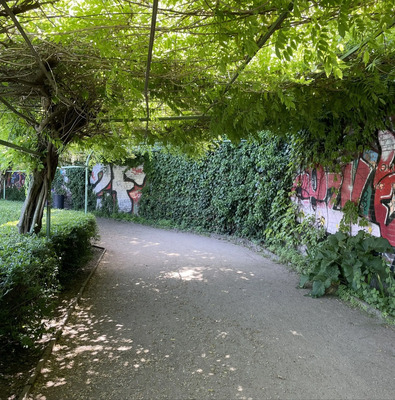
On hot summer days you might see people inside the pond. This is not recommended. Or legal. Not anymore.
Engelbecken was once used for swimming. In the ...
 View locations and route

How VoiceMap Works





Major Landmarks
 Major Landmarks
-
The Treehouse
-
St. Thomas Church, Berlin
-
Engeldamm 62
-
Michaelkirchplatz
-
Engelbecken
-
Waldemarbrücke
-
Erkelenzdamm 9
-
Park am ehemaligen Luisenstädtischen Kanal
-
BeginenWerk e.V.
-
Grundstücksgesellschaft Elisabethhof mbH
Getting There
 Getting There
Route Overview
-
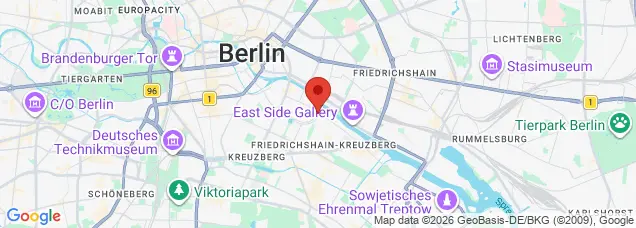
Start locationKöpenicker Str., 10179 Berlin, Germany
-
Total distance2km
-
Final locationKreuzberg, 10967 Berlin, Germany
-
Distance back to start location2km


Directions to Starting Point
The tour begins in Köpenicker Straße on the border between Berlin-Mitte and Berlin-Kreuzberg: on a small green right between Bethaniendamm and Engeldamm and south of the River Spree with Schillerbrücke.
Walk across that bridge, if you arrive by an S-Bahn train and get off at the station "Ostbahnhof" north of the river. You can also reach this spot by bus: there are several lines stopping at the halts "Bethaniendamm". You can also go to U-Bahn stations "Heinrich-Heine-Straße" or "Schlesisches Tor" and walk from there or use an electric scooter.
The small green is located at the northern end of the former canal and now public park built within its bed. A low red-brick wall marks its northern limit. This is where we begin our audio-tour: stand before that brick embankment - more or less in the middle - and turn to face the sunken garden and, a bit further on the left, a red-brick church with a round roof.
 Show Directions



Tips
 Tips
Tips
Places to stop along the way
If you have time and feel like visiting a place or two on the way, I highly recommend going to see the Bethanien - second oldest Berlin hospital and now excellent art venue (it houses a lot of ateliers) at Mariannenplatz 2 on the other side of Bethaniendamm street.
This is also where you can get a lovely meal or just enjoy a glass of beer while sitting under old trees: Drei Schwestern
inside the historic Bethanienhaus building are a delight both indoors and outside in the garden. Just enter the main building directly from Mariannenplatz, walk through the door leading to the ground floor corridor, turn left and go to its end. Or just follow other merry diners.
A bit further down out route, you can also make a quick dash to the other side of the old canal - to Miachelkirchplatz. The church standing there, Michaelkirche (Saint Michael's), is not what it appears to the eye. Destroyed during WW2, it was restored but without recreating the interior. The large nave has no roof - it is a beautiful hidden garden, which is sometimes open to visitors. Occasionally there is a small cafe there, serving coffee and cake.
When in Oranienplatz, you might want to branch out into Oranienstraße (going left from Oranienplatz would be the best, if you just want to get a taste of it). The street is one of the oldest in its part of Berlin but as young and vibrant as it has always been. On the left side of the street behind the junction with Adalbertstraße, you will find a historic Blindenanstalt (Institute for The Blind), opened in 1902 in school buildings erected in forty years earlier. Today, it is still used as a social institution - this is where many blind or otherwise impaired people find work, producing, among others, absolutely wonderful handmade brushes, toys, stationary products sold at the inhouse shop, The Imaginary Manufacture
. You will find it at Oranienstraße 26.
Between the elevated railway viaduct in Skalitzer Straße and the Landwehrkanal, on the left, you will be passing several small cafes and restaurants, if you seek pleasant refreshments.
At the end of the audio-tour I will also tell you where to go from there, whether you want to explore further or simply sit down and enjoy the view.
Best time of day
From dawn till dusk. Rush hour might be of any importance only when you have reached Oranienstraße and then Skalitzer Straße, otherwise it is a very peaceful, relaxed walk.
Precautions
Be always aware of your surroundings, especially if you decide to walk along the sunken gardens - although relatively safe, you will encounter some homeless people camping along the route. Their presence should not disturb you (it being Kreuzberg, the homeless are welcome in the area) but it is always good to assess the situation before nearing them.
The other thing to keep in mind at all times: this is a nearly four-million-strong city and it often feels that at least half of those four million are on the move somewhere using bikes, e-scooters and automobiles. All rules of survival in traffic apply.
Get The App
 Get The App




Scan to get app
Download the app for free
VoiceMap




 App of the Day

 Editor’s Choice


 Last Updated
 Questions and Reviews